
Avatar

Shariq Mohammed

Assistant Professor of Biostatistics

Boston University

Biography

I am an Assistant Professor in the Department of Biostatistics at Boston University School of Public Health and a Rafik B. Hariri Junior Faculty Fellow (2022-2025) at BU’s Hariri Institute for Computing and Computational Science & Engineering. I build statistical models and computational tools that turn high‑dimensional, complex‑structured data into clinically useful insight.

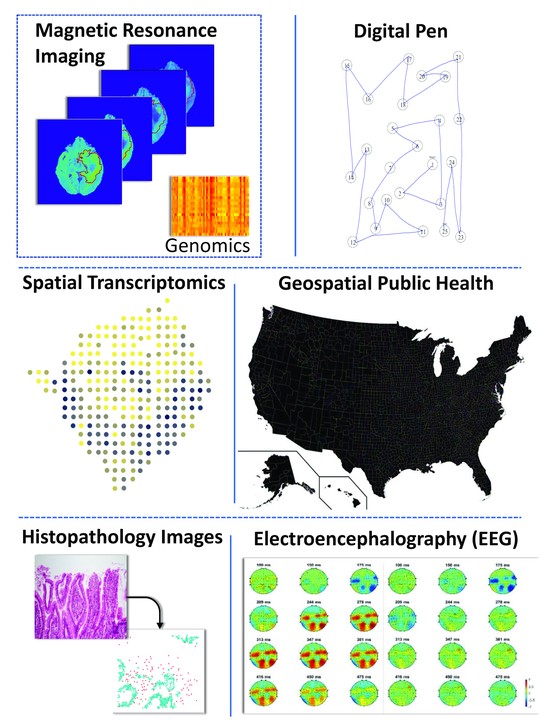
My group develops methods at the interface of hierarchical Bayesian modeling, variable selection, functional & geometric data analysis, spatial statistics, network models. We work with digital, spatial‑omic, geospatial, and imaging data, with applications in neurodegenerative disease (with a focus on dementia and Alzheimer’s disease) and oncology. Our research aims to develop interpretable features, reliable prediction models, and biological explanations that support better decisions in patient and public health.

Before BU, I was a postdoctoral research fellow in Biostatistics and in Computational Medicine & Bioinformatics at the University of Michigan–Ann Arbor, and a Precision Health Scholar. I received my Ph.D. in Statistics from the University of Connecticut.

Interests

  • Bayesian Modeling
  • Variable Selection
  • Functional / Geometric Data Analysis
  • Spatial Statistics
  • Medical Imaging Analysis
  • Digital & Spatial‑Omic Data
  • Geospatial Methods
  • Neurodegeneration & Cancer

Education

  • Ph.D. in Statistics, 2018

    University of Connecticut

  • M.S. in Statistics, 2017

    University of Connecticut

  • M.Sc. in Applications of Mathematics, 2014

    Chennai Mathematical Institute

  • B.Math.(Hons.), 2012

    Indian Statistical Institute
Research & Funding

.js-id-Applications

Research Funding

Our research is supported by

  • NIH / NHGRI
  • NIH / NIGMS
  • NIH / NINDS
  • Framingham Heart Study – Brain Aging Program (FHS‑BAP)
  • BU SPH – Population Health Data Science (PHDS)
  • BU SPH – Early Career Catalyst Award
  • U‑M Precision Health – Scholars Award

Complex-structured data applications

We design statistical models and computational tools that turn high‑dimensional, complex‑structured data into clinically meaningful insight. What we do? Create novel, interpretable, and useful features from complex data. We generate and derive feature sets that capture signal in digital data, spatial‑omic data, geospatial data, and imaging data, providing surrogate representations of complex data that power downstream discovery and decision‑making. Predict clinical phenotypes. We integrate biomarkers derived from complex‑structured data to build statistical and machine learning models to predict clinical characteristics that matter to patients and providers.

Statistical methods for the analysis of complex-structured biomedical data

We develop innovative statistical methodology that turns the structure in data into signal—explicitly leveraging complexities of data from modern biomedical technologies. Hierarchical Bayesian modeling to encode domain knowledge and to propagate uncertainty. Variable selection to pinpoint a parsimonious set of biomarkers from high‑dimensional feature sets. Geometric & functional data analysis to analyze shapes, curves, and trajectories. Spatial statistics to exploit spatial dependence in data. Network models in statistics & machine learning to learn interaction structure and to infuse graph constraints.

Publications

.js-id-Journal-Articles

Statistical Analysis of Quantitative Cancer Imaging Data

Statistics and Data Science in Imaging (2024). Abstract Recent advances in medical imaging technologies have led to the proliferation …

Modeling health and well-being measures using ZIP code spatial neighborhood patterns

Scientific Reports (2024). Abstract Individual-level assessment of health and well-being permits analysis of community well-being and …

Tumor radiogenomics in gliomas with Bayesian layered variable selection

Medical Image Analysis (2023). Abstract: We propose a statistical framework to analyze radiological magnetic resonance imaging (MRI) …

Bayesian variable selection in double generalized linear Tweedie spatial process models

The New England Journal of Statistics in Data Science (2023). Abstract Double generalized linear models provide a flexible framework …

Network-based Modeling of COVID-19 Dynamics: Early Pandemic Spread in India

Journal of the Indian Statistical Association Abstract: Modeling the dynamics of COVID-19 pandemic spread is a challenging and relevant …

Spatial risk estimation in Tweedie compound Poisson double generalized linear models

International E-Conference on Mathematical and Statistical Sciences: A Selçuk Meeting (ICOMSS 2022) Proceedings Abstract: Tweedie …

Integrative Bayesian Models Using Post-Selective Inference: A Case Study in Radiogenomics

Biometrics (2023). Abstract Integrative analyses based on statistically relevant associations between genomics and a wealth of …

GaWRDenMap: A quantitative framework to study the local variation in cell-cell interactions in pancreatic disease subtypes

Scientific Reports (2022). Abstract: Spatial pattern modelling concepts are being increasingly used in capturing disease heterogeneity. …

RADIOHEAD: Radiogenomic analysis incorporating tumor heterogeneity in imaging through densities

Annals of Applied Statistics (2021). Abstract: Recent technological advancements have enabled detailed investigation of associations …

Spatial Tweedie exponential dispersion models: An application to insurance rate-making

Scandinavian Actuarial Journal (2021). Abstract: In this paper we propose a statistical modeling framework that contributes to …

Scalable spatio-temporal Bayesian analysis of high-dimensional electroencephalography data

Canadian Journal of Statistics (2021). Abstract: We present a scalable Bayesian modeling approach for identifying brain regions that …

A Bayesian 2D functional linear model for gray-level co-occurrence matrices in texture analysis of lower grade gliomas

NeuroImage: Clinical (2020). Abstract: In cancer radiomics, textural features evaluated from image intensity-derived gray-level …

Classification of high-dimensional electroencephalography data with location selection using structured spike-and-slab prior

Invited for Statistical Analysis and Data Mining Best Paper Session at Joint Statistical Meetings 2022. (JSM 2022 Program) Statistical …

Biomedical applications of geometric functional data analysis

Handbook of Variational Methods for Nonlinear Geometric Data — Springer (2020). Abstract: In this chapter, we describe several …

Bayesian variable selection using spike-and-slab priors with application to high dimensional electroencephalography data by local modelling

Journal of the Royal Statistical Society: Series C (Applied Statistics) (2019). Abstract: Because of the immense technological …

Assessing malaria using neutral zone classifiers with mixture discriminant analysis on 2D images of red blood cells

Journal of Biostatistics and Epidemiology (2019). Abstract: Background and Aim: We aim to build a classifier to distinguish between …

A dynamical systems approach to systemic risk in a financial network

Indian Control Conference (ICC 2016) Proceedings. Abstract The insolvency of a financial entity such as a bank can trigger a sequence …

Contact

  • shariqm at bu dot edu
  • Crosstown Center (CT-303), 801 Massachusetts Ave, Boston, MA 02118